Tuesday, 20 January 2015

Ned Devine - The Prince of Whips

Ned Devine – The Prince of Whips

When Cabbage Tree Ned Devine arrived in Otago in November 1863, he was already rich and famous. The Otago Daily Times described him as “the best known and most popular of the Victorian whips” (‘whip’ being the popular name for a coachman) – and for once, this was no exaggeration.  As a youngster, Ned had acquired a reputation as a skilled handler of large teams and for a time he had driven a Cobb and Co ‘Leviathan’ between Geelong and Ballarat.  This enormous double storied coach could hold up to eighty nine people and was pulled by a team of twenty two horses.   Driving a Leviathan required special skills; apart from the ever present danger of bushrangers, the driver of this mega-coach had to direct horses that were beyond the reach of his whip.  Stones were thrown to encourage lagging horses to speed up and Ned was known to drive the coach holding reins in one hand and a pistol in the other in order to discourage bushrangers.

Ned Devine and the Leviathan outside the Black Bull Hotel, Geelong, Victoria
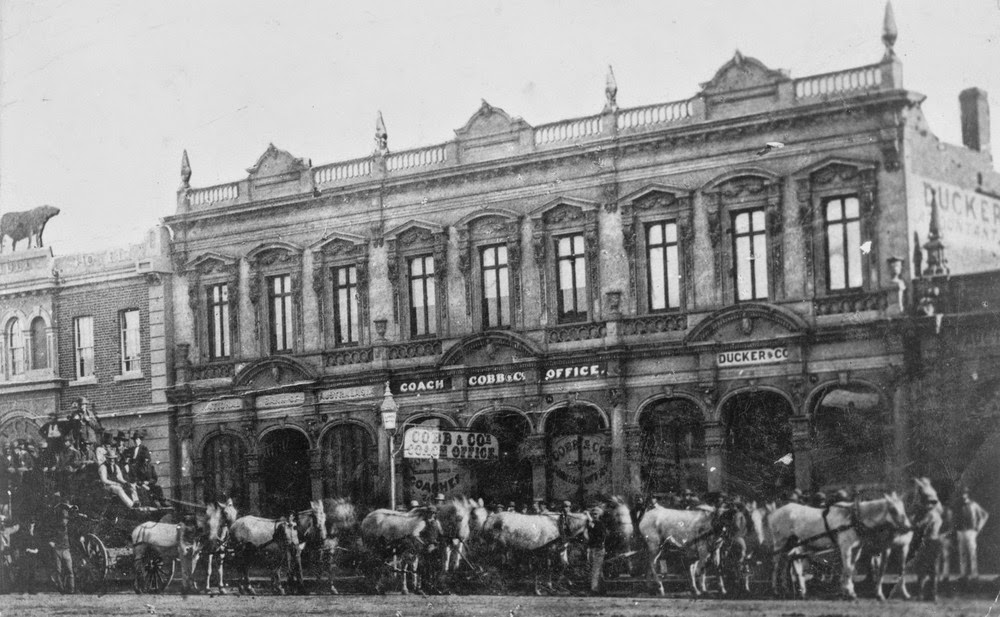
On one occasion Ned drove at speed directly through the middle of the bloody Eureka Stockade conflict; on another occasion when his coach’s brakes failed on a steep incline he avoided disaster by whipping his team into a gallop in order to prevent them from being crushed by his runaway carriage.  However his most newsworthy exploit was far less dangerous.  When the English Cricket Team paid their inaugural visit to Australia in 1862, Cabbage Tree Ned was chosen to be their driver. With typical showmanship, he drove their carriage, pulled by a team of twelve grey horses directly onto the Geelong Oval, providing a spectacular start to the match.  At the conclusion of their tour the English team awarded Ned three hundred sovereigns as a token of their gratitude.                                                     Canny Ned used this money to travel to New Zealand – railways were encroaching on the Australian coach routes and the goldfields of pioneer New Zealand provided fresh opportunities for a man with his particular skills.  Ned was employed by Cobb and Co and soon became a regular driver on the Dunedin to Palmerston route. 

Ned Devine in Palmerston in the 1870's           
               
Ned had acquired the name ‘cabbage tree’ on account of the type of hat that he habitually wore – a type of panama woven from the leaves of the Australian cabbage tree palm.  This explanation was too colourless for the garrulous Ned however.  On one occasion he convinced a visiting Englishman that he had acquired the name because he had been abandoned in a cabbage tree as a baby and had been rescued by Maori.                                                                                          

Cabbage Tree Ned soon gained a reputation as a prankster, raconteur and rebel who was as fond of a yarn as he was averse to bureaucracy.  Children enjoyed the sweets that he carried in his pockets, Men admired the skill he demonstrated in navigating the atrocious roads of Otago, and Women respected his chivalry. When his horses tired on the Kilmog hill, gentleman were instructed to get out and walk, and the much valued ‘box seat’ beside the driver was always reserved for a lady.  A seat in the fresh air was vastly preferable to one inside the crowded swaying coach – an experience that was likened to travelling in an enclosed rowboat.       

His yarns and jokes became legendary, on one occasion he dispatched an undertaker to measure a man for a coffin.  Ned cheerfully refunded the undertaker’s expenses for a wasted journey – the man that he had been sent to measure being found to be alive and quite well.     His passengers often bore the brunt of his hoaxes.  When the coach stopped at various taverns admiring travellers often bought him drinks.  The barmen knew him well and would substitute neat brandy when he ordered a ‘Sarsaparilla and bitters.’  When a passenger questioned the strong smell of liquor, Ned told him that he added brandy to the horses feed in order to give them ‘wind’ (stamina).  On another occasion Ned informed a passenger who was carrying a bundle of fresh fish that unspecified poisons in the waters where his catch had been landed would make the fish inedible.  The disappointed passenger left his bundle behind when he alighted; that night Ned enjoyed a fine fish dinner. The rich and famous were not immune from his jokes; he once questioned Johnny Jones while driving him between his properties in Waikouaiti and Dunedin. “Is it true Mr Jones, that each of your daughters will receive ten thousand pounds when they marry?” When Jones confirmed the fact, Ned offered to take Jones’s (plain?) youngest daughter, Janet off his hands for a knockdown price of five thousand.                                                                                                     
Coachmen often delivered news as well as passengers and goods to remote communities.  In 1869 the paddle steamer City of Dunedin disappeared while en route to Dunedin, the vessel’s loss caused great consternation. A certain gentleman (who should have known better) asked Ned for news, and accepted his reply that the vessel had anchored safe and well in Waikouaiti. The news was telegraphed to Port Chalmers, just in time to make the morning edition of the ‘Times.’  A meeting was convened and a vessel was dispatched to Waikouaiti, the rescue attempt being based on nothing more than a second hand report of Ned’s flippant remark.   When no ship was found, Ned the prankster was criticized “for treating with levity a calamity which has thrown so many into mourning.” He was soon forgiven however; in 1869 he was “entrusted the duty of tooling the eight greys which drew the first Royal personage (the Duke of Edinburgh) to Dunedin” 
                                                 
Ned tired of ‘tooling,’ when bureaucracy began to impinge on his driving.  In 1873 he was charged with allowing passengers to sit on the luggage on top of his coach and in 1874 an attempt was made to fine him for allowing his horses to round a corner at a trot.  A year later at a meeting in Hawksbury, Ned tendered his application for the position of curate in the Waikouaiti Church of England.  Whether this was another prank or an honest attempt to change profession, Ned was denied the opportunity to join the clergy.  A more suitable candidate was quickly appointed; Church hierarchy having sensibly recognising that in Ned’s case popularity would be no substitute for piety.  

In 1878 Ned retired from driving coaches, warning his successor to ‘mind the peat bog and give my love to the tussocks.’ He settled in the Waikouaiti district where for a time he adopted the lifestyle of a country gentleman, breeding and racing horses and dogs. A year later the Tuapeka Times reported that Ned had inherited a fortune.  This was very possibly another instance where a publication rashly accepted one of Ned’s anecdotes as truth.  Ned never conspicuously” occupied the position of a millionaire,” six months after this rumour was published he purchased the dilapidated Commercial Hotel in Waikouaiti – a strange acquisition for a supposedly wealthy man.  Ned’s tenure as a publican was short lived, the Commercial Hotel’s license was not renewed and in September of 1882 Ned was declared bankrupt.  His fortunes did not improve and some years later he returned to Australia.   
            
In 1891 it was reported that “Cabbage Tree Ned, the prince of coach drivers” was a member of Doctor Carver’s Wild West Company. The show was enthusiastically received by Melbourne audiences.  ‘Cowboys’ demonstrated sharp shooting and trick riding while on an imaginary prairie ‘Indians’ attacked a settlers’ cottage and chased a stage coach driven by Ned. There were worse roles to play, the Melbourne Argus described the scene in which a horse thief was lassoed and dragged behind a horse “a decidedly unpleasant experience for the man who is called upon to play the corpse.”  In later life Ned once again fell upon hard times, in 1904 he was admitted to the Ballarat Benevolent Asylum – an institution that housed “the poor and distressed, with a view to affording them consolation and assistance in old age.” He became a well-known figure driving the institutions Waggonette on the streets of Ballarat until his death aged 71, in 1908.   

Ned was buried in a pauper’s grave; however some years later admirers raised funds to erect a suitable memorial.  In 1937 Ned’s remains were relocated to a fine tomb in a prominent location, its headstone is appropriately inscribed with a tiny Cobb and Co Coach. 

Sunday, 23 November 2014

Insanity, Induced by the Aspersion of Character


On the first day in May 1871, nine year old Mary Ann McPhee ran out of the All Seasons Hotel in Caversham Dunedin, screaming “Da, mother’s killed herself and Nelly.”  The very next day Mary Ann was forced to relive that scene – she was called to the stand to give evidence at the coroner’s inquest into her mother’s actions.

 “Yesterday, about half past seven whilst I was dressing myself, I thought I heard a noise like a cock crowing.  I looked into the room I heard the noise coming from and saw my mother, Agatha McPhee lying on the floor with all her clothes on, cutting her own throat.  My sister Nelly lay on the floor; my mother’s head was on her hip.  I asked my mother who had killed Nelly and she touched her own breast meaning it was herself.”  Mary Ann went on to explain that earlier that morning her sister had been “running about among the neighbours” before her mother had picked her up and carried her inside. She had heard Nelly ask her mother where they were going, to which her mother had replied “I am going to take you to heaven.”

Various neighbours rushed to the scene.  Women bound the wounds on Agatha’s neck and the doctor and constable were sent for.  There were immediate concerns for the safety of the remaining McPhee children, but after some initial panic, the youngest child was found alive and well upstairs.  Agatha later admitted that she had initially intended to kill first Nelly and then the baby before taking her own life.

The incident was immediately and melodramatically reported.  The Dunedin Evening Star described it as “a tragedy so horrible in its character that the bare thought of it almost makes one’s blood run cold.”  The bodies were depicted as lying “weltering in blood” and “fair haired Nelly, barely four years of age” (who was “rather helpless through paralysis in the side”) was reported to have been almost beheaded, her neck having been hacked at with an eighteen inch butcher’s knife until her head was only connected to the body by a small band of flesh.  The article concluded by suggesting that a motive would soon be revealed.

Agatha did not die quietly.  To quote the Star – “She had a long cut across her throat, but her efforts to deprive herself of life were not so determinedly made as they were upon her child – none of the main arteries were severed.” Doctor Hammond sewed up the wound in her neck, and pronounced her survival to be doubtful, however despite her weakened condition Agatha could still communicate and was determined to explain her actions.  While she was still able to speak she asked her husband to forgive her and repeatedly demanded that a man named Peter Kane should be brought to her.  When unable to speak, she wrote notes.  In a message to Constable Anderson, she wrote “I wish to live until I see the man that took such advantage over me.  Send for him.” A Justice of the Peace was summoned and Agnes dictated several written statements that were witnessed in his presence. Peter Kane never faced his accuser that day, however witnesses who were present during Agatha’s final hours were left in no doubt that he was the person who had caused Agatha’s unspecified sin and shame.

The incident had been no secret.  At the inquest, a labourer named John Swain testified that Agatha had confided in him.  He described how a “very affected” Agatha, “scarcely able to speak” had told him that on the previous Wednesday night, during her husband’s absence, Peter Kane (her husband’s business partner) had entered her bedroom and had “laid hands on her”.  She had fought him off by fetching a carving knife and threatening him with it.  The following morning Kane had called her a whore (and worse) and threatened to destroy her good name if the event ever came to court.  John Swain advised Agatha that it was her duty to tell her husband and described leaving her “in a very sad state.”

As she lay dying, Agatha whispered to a neighbour that she had decided to kill herself and her two youngest children if her husband took the news of her attack badly; “if he cannot take it well, I can never look him in the face again.” Unfortunately, Donald McPhee reacted predictably poorly to the news of his wife’s abuse and Agatha revealed to the neighbour that after “seeing him crying and so much put about” she had made up her mind.

At the inquest Mary Ann McPhee testified that she had heard her parents talking, (but not quarrelling) in the night then had heard her father crying. Donald McPhee testified that he had wept at the news but had ‘no occasion to suspect his wife’s honour’ and had persuaded her to take the matter to court.  Agatha had reluctantly agreed, despite being “averse on the grounds of delicacy and nervousness” and distressed at the prospect of having her good character questioned.

Her death was protracted and degrading.  In the afternoon, Doctor Hammond found her to be “somewhat stronger and rational.” Agatha was able to ask whether Nelly had been laid out, (she had) and stated that it was too late for regrets but that she hoped that nobody would blame her husband for her own actions.  By evening her condition had deteriorated.  When Agatha rose up and attempted to tear open her throat wound the doctor was recalled. Finding her exhausted from her struggles and judging that she had a “better chance of recovery than of dying if she was kept quiet,” Doctor Hammond declined to sedate her, ordering instead that she should be confined to a straight jacket and tied down.  “After struggling for some time in the jacket and attempting to get off the sofa to which she was bound, she died suddenly from exhaustion following a self-inflicted wound, and from the shock to her system.”

The verdict of the Coroner’s jury was that Agatha and Nelly had died from wounds inflicted while Agatha was in a state of “temporary insanity induced by aspersion to her character.”  Peter Kane was charged with intent to commit rape and was remanded in custody. 

The exact nature of Kane’s physical assault was never specified.  With typical Victorian modesty Agatha had used euphemisms to describe the attack.  The clearest indication of exactly what had occurred that night was given by her husband Donald.  At the inquest he alleged that his wife had told him that Kane had taken hold of her and that despite her struggles he had “accomplished what he wanted.” Days later he published a hasty and very unfortunate retraction in the Otago Daily Times.  In a clumsy attempt to portray Agatha as an innocent victim, Donald’s written statement had completely exonerated Peter Kane of the crime of rape.

His posthumous attempt at salvaging his wife’s reputation destroyed the police case against Kane – they refused to pursue the prosecution however Donald McPhee chose to proceed with a private prosecution (ignoring the judge’s advice).  The case was hopeless.  Witness statements were regarded as hearsay and ruled inadmissible and Agatha’s delicately worded sworn written statements were so nonspecific as to be useless.  Peter Kane was judged to be innocent.                      
                                                              

Nelly was buried in the Southern Cemetery in Dunedin, when Donald died eight years later he was buried alongside his daughter.  Mary Ann never married; she died in 1923 and was also interred there.  The family plot bears no ornamentation or headstone and is identified only by surname.  One additional body only identified as ‘McPhee” was buried there six months after Donald’s death. It would be nice to think that a family member might have had Agatha’s body exhumed and quietly buried alongside her husband.                                     
                                                                                            
Wife and mother, Agatha McPhee deserves to be remembered as the person that her friends and family described. In typical understated Victorian fashion Donald said “she was sensitive but sensible and intelligent, I never had an angry word with her.” Another newspaper account relates that she was “much respected by all her acquaintances as a quiet and industrious woman.” 

Thursday, 16 October 2014

Murder or Suicide?

In 1862, Julius Vogel was Waikouaiti’s elected representative on the Otago Provincial Council.  Ten years later the ambitious Vogel had been appointed to the position of colonial treasurer and in this capacity he instigated New Zealand’s grandest ever public works scheme.  Vogel – the Rob Muldoon of the nineteenth century, borrowed enormous sums of money from Britain in order to boost migration and build infrastructure.  He promised to build a thousand miles of railways in order to open up inaccessible land (much of it confiscated during the Maori wars) and vowed that this target would be met within nine years.

Thousands of men were needed to help construct Vogel’s railways; however, in 1870 a work force of that size simply didn’t exist.  The English firm contracted to build the rail network, were obliged to recruit more than two thousand men to meet this labour shortage.  These strong but mostly unskilled  ‘navvies’ were given free passage to New Zealand and promised two years steady work. On arrival, these men soon discovered that the salaries they had been offered in England were not as generous as they had first supposed – parity with colonial wages and working conditions (an eight hour working day!) was demanded. 

The recruitment scheme was something of a disaster, immigrant railway workers arrived faster than engineers could organise work for them, and the experienced agricultural workers among them soon found employment elsewhere.  Having paid nothing towards their passage, these men found they had little to lose by breaking their contracts; the majority simply walked away avoiding prosecution.  Within a very short period of time another labour shortage loomed. Several recruitment alternatives were considered and dismissed, Maori were considered to be ‘inefficient’ workers, and the importation of Chinese labourers was actively opposed by provincial authorities.  The shortage was eventually alleviated by an influx of German and Scandinavian immigrants and by settlers from the United Kingdom who enjoyed free passage to New Zealand during 1873.                                                                                             
A few years later the government sought to combat the ‘unemployment outcry’ by reserving sections of railway construction for the jobless,  in 1876 an able bodied unemployed man could earn 6s 6d a day on the Waikouaiti
railway works, carrying out “fencing, earthworks and laying the permanent way.” There was no excuse for the fit and healthy men of Otago to remain idle. 

Railroad workers were a diverse group, ethnicity, skills and motivation varied widely, but all workers shared the same difficult working conditions.  Picks, shovels and dynamite were used to break hard ground, and barrows were used to move it.  Injuries and fatalities were not uncommon. In 1878 a young man named James Patterson took up work on the Waikouaiti railway after failing to make his fortune in the goldfields.  “Slung in a boatswain’s chair on the side of a steep precipice near Purakanui station”, Paterson was clearing away loose stones when he fell fifty feet, striking his shoulder then fell fifty feet further, smashing his head on the railway track. He was taken into the guard’s van of the Waikouaiti train “in a dying state” and was dead before the train reached Dunedin. 

Men who faced such risk for a reward of six shillings a day could hardly be blamed for choosing to slip away into bush.  Absenteeism was widespread and individuals regularly absconded from the transient workforce.  The disappearance of a single man from a railway ‘navvy’ camp would have raised no suspicions, the absence would have been attributed to desertion – foul play would never have been suspected.
The Waikouaiti to Palmerston section of the main trunk line was completed in September 1878.  When a skeleton was found in a railway drainage ditch beside the Waikouaiti station in 1890, the railway completion date became important.  Because the ditch had been dug no later than 1878 there was a twelve year period during which a body had been concealed.

The journalist who reported the discovery was eager to present an unbiased account of the find.  The original newspaper headline read “Murder or Suicide?” The article suggested that the death was either a “ghastly murder” or a “determined suicide.” It was not considered unlikely that a truly determined man might have tied himself up in a small sack containing two heavy pieces of iron, and drowned himself in a ditch containing no more than three feet of water. 

Uncommonly hot conditions dried the ditch exposing the remains, two boys aged ten and nine removed the skull and eventually informed their parents of the find.  The skeleton was taken into the possession of Sergeant Conn, of the Palmerston Police who made “careful enquiries but failed to find that anyone in the district had been reported missing since 1878.”  Initial medical investigations ascertained that the bones belonged to an aged man, 5 foot 9 inches in height.

Further forensic examination of the remains was more detailed.  Walter Hislop, a Surgeon from Palmerston examined the skeleton.  During the inquest that was held in Waikouaiti, he reported that the skull was of the “Mongolian type” with a massively wide lower jaw and had teeth that were “stained yellow, as if from Opium smoking.” He remarked that “the head was a large one, on a small body, no more than five feet in height and concluded that the evidence suggested that the bones had belonged to a Chinaman. The coronial jury returned a unanimous verdict, in their opinion there was a very grave suspicion that the unnamed man had met his death through foul play.

The local newspapers presented several theories as to the timing of the murder and identity of the victim. They postulated that the dead man might have been a railway ‘navvy’ whose body was placed in the ditch around the time that the railroad was being built.  Alternatively, it was suggested that the corpse might have been placed in the ditch some years after the railway was completed and that it may have been transported there from a nearby local hotel.  No sightings of a very short Chinaman with a disproportionately large head were ever reported.

Within weeks newspapers reported a ‘satisfactory or possibly ludicrous’ revelation.  An unnamed local man claimed that a ‘gorilla’ from a travelling circus had died when its company were passing through Waikouaiti and that its remains had been hastily placed in a gunny bag and thrown into the convenient ditch.

An article in the North Otago Times reported satisfaction that ‘foul murder’ had not been committed on a human being and ridiculed the solemn coroner’s enquiry.  The credibility of the surgeon who had identified the skull as belonging to a ‘Chinaman’ was also questioned, but in fairness the article also noted that “the skull of a gorilla accords in shape with those of some members of the human family, a fact that gives us reason to have faith in Darwin.” In an final effort to remain impartial the closing sentence of the newspaper article read:

“However, the gorilla story might be a joke.”

Sunday, 12 October 2014

Simply not Cricket

European settlers developed a mania for ‘the gentleman’s sport’.  Dunedin boasted sixty cricket clubs, but in this Presbyterian enclave enthusiasm outweighed opportunity; local grounds were scarce,  play was forbidden on Sundays and the season was constrained by poor weather.  Consequently Dunedin teams were often obliged to play ‘away’ and so on March 1st 1880, Dunedin’s Excelsior Club travelled thirty miles north to engage the Palmerston Club in a ‘friendly’.
The venue was not to the visitors liking.  A local farmer had moved his cattle, a pitch had been mown and cow muck raked towards the boundaries but the ground was still rutted and uneven. 
The local team, who were accustomed to playing on an irregular surface elected to bat first and gained a creditable fifty three runs. Excelsior replied with sixty four, a score that was entirely attributable to boundaries scored from the occasional straight delivery.
During elevenses, the home team trampled corrugations from the pitch while Excelsior strategized. When the home team once again resumed batting, Excelsior established an attacking field; their men gathered close enough to ridicule the batsman while the bowlers threw bouncers and deliberately rushed the delivery of overs.  The Excelsior scorekeeper maintained a constant tirade of encouragement from the sidelines and the unnerved home team were soon all out for thirty four.
Each ball of the final innings was deliberately directed towards the boundaries and by the time Excelsior were dismissed for seventy seven, the Palmerston fielders were thoroughly soiled with cow-muck. Defeated but not dispirited, the home team proceeded to congratulate their opponents!  Filthy hands were enthusiastically offered and the Excelsior players pristine backs were heartily slapped and smeared.

The scorekeeper remonstrated, so Palmerston’s captain tossed him a ball – it would have been better if he had dropped this catch – the missile had not been fashioned from leather.


Big Mere

My father was a giant foreigner, an American Pequot Indian who escaped his homeland by exploiting his strength and stature. Whaling fleets carried him southward to Huriawa, in the days when tohorā still visited these waters.  My mother claimed to have been drawn to his warrior spirit, while her dark hair, eyes and complexion reminded him of the women in his tribe.     At the insistence of the resident missionary they were married and the evidence of their sins – their baby girl, was baptised.  I was christened Mere, a name that was biblical enough to appease the Reverend Watkins and appropriately descriptive of my shared warrior heritage.
My father gifted me his prominent cheekbones, aquiline nose and his stature, features of which I was very proud.  In those days life was hard, to travel we walked and every scrap of food had to be foraged by hand.  Strong arms and legs and a sturdy back were enviable attributes in a time when horses and oxen were unimaginable prizes.  My father's employer Rangatira Jones had recently acquired the very first horses ever to have been seen in this part of the country.  The animals’ arrival created great interest, their usefulness was as undeniable as their value; the horses’ shelters were finer than our own.
Rangatira Jones intermittently welcomed newcomers who would scratch the sour soil as unsuccessfully as their predecessors had done. They arrived by boat and were always reluctant to wet their fine boots.  As a sign of welcome, we assisted and so I allowed a boy to clamber onto my back.  He kicked at my sides, urging me onwards.  I remained oblivious of his insult until he began to whinny.  He was easily dislodged.  As he spluttered and choked we laughed, “Better to be the beast than its burden eh?”


The First Recorded Murder in Otago


A month before Johnny Jones’s pioneering farming families arrived in Waikouaiti, a shocking incident confirmed Otago’s reputation as a lawless and dangerous outpost. Otago’s first murder and its aftermath highlighted the perils of allowing an outpost to remain ungoverned.  

In 1835, Charles Darwin described the young colony’s European inhabitants as “the very refuse of society” and in the five years that followed very little had changed.  Before the arrival of settlers the European population of Otago consisted of around forty sealers, whalers and a few merchants who supplied the inhabitants with the necessities of life – predominantly grog and tobacco. Many local Maori followed the example set by these men, quickly becoming hopeless alcoholics.  The Reverent Watkin correctly observed that the “love of strong drink appears to be the source of much of the evil here”.

 At twenty four years of age Teuteraki Pauwa was a handsome young man who was well connected.  The son of a local chief, Teuteraki was described as being ‘well made’ and having a ‘pleasing expression of countenance.’ Unfortunately, newspaper accounts (written years later) also describe Teuteraki as a ‘libertine’ who possessed a ‘crafty and vengeful disposition’.  In an outpost where alcoholism and bigotry were common, it may have been convenient to attribute Teuteraki’s actions to a character defect, but they could more accurately have been ascribed to drunkenness; on the night of February 15th, 1840, Teuteraki Pauwa had been drinking heavily.
For some years Teuteraki and a whaler-sealer by the name of James Brown had been in dispute, and on this night, Teuteraki made several unwelcome visits to Brown’s whare in the settlement of Otakou. Tempers rose and a brawl erupted, in the confusion a window was broken and Teuteraki was cut by flying glass.  The inhabitants of the whare brandished an unloaded musket to warn the enraged, drunken intruder away. He fled, but returned a short time later, firing his own weapon through the broken window.  

The bullet missed James Brown – the intended target, and lodged in the neck of a visiting ship’s carpenter. While the local population tended to the dying man as best they could, Teuteraki fled into the bush.  At daybreak the next morning a search party was dispatched but the fugitive could not be located.  It would have been better if he had remained hidden, but later that day Teuteraki returned and surrendered himself to the Europeans, thereby presenting them with an impossible dilemma.

The nearest judicial authorities were located in Sydney, or in the Bay of Islands.  Several American whaling ships were anchored nearby but no captain was willing to suspend commercial activities in order to transport a prisoner.  The captains were not unsympathetic however; an immediate American style lynching was suggested, but was rejected by the Europeans who preferred the penalty of shooting to hanging.  When the Europeans surmised that a volunteer executioner might himself eventually be tried for murder, one of the American captains offered free passage to America to any man who was willing to ‘dispatch the native.’

Since no volunteer could be found to immediately murder the prisoner, Teuteraki was locked in a small room until alternative transportation arrangements could be made.  His European visitors vividly described to him the shame that was associated with criminal conviction and transportation to the prison colonies in Australia and the brutal conditions that he could expect to encounter there.

Teuteraki begged his jailers to kill him, but he could persuade none of the Europeans to shoot him. No man was willing to act as his executioner no matter how hard he begged them to end his life.  There were easier ways to assist his suicide however.  While most of the Europeans were occupied elsewhere Teuteraki was provided with a loaded musket.  Dressed in his best clothes and accompanied by his wife he sat on the floor of his cell.  His wife positioned herself behind him with her chest pressed tightly against his back and her arms wrapped around his waist. He used his toe to pull the trigger.  The bullet passed through his chest and lodged in his wife’s heart.  They died together instantly.

This was not the end of the matter.  Local Maori were enraged by the manner in which Teuteraki and his wife had died.  When Johnny Jones's settlers arrived in Waikouaiti in March 1840, the European residents of Otakou were still expecting a Maori uprising in revenge for the deaths.  Happily the revolt never eventuated.  Discontent abated in April when James Brown and his wife were spirited away to the Bay of Islands by the French explorer d'Urville.  Soon after, the newly arrived Reverent Watkins began to exert his calming influence over the native population and the lawless European whalers.  Within a year the Reverent was able to report that "amid the wreckage of an ancient order a new life begins to emerge." 

 
Otakou in 1840


A Sensational Arrest near Waikouaiti

At around ten O’clock on the night of Sunday March 14th, 1880 a tired and weary gentleman with a “listless attitude” sat in the dining room of the Saratoga Hotel in Blueskin.  In the adjoining bar, the hotel’s proprietor was discussing the shocking murders that had occurred earlier that same day in Dunedin.  A witness noted that having overheard this conversation, the ‘tired gentleman’ became anxious, restless and impatient and left the hotel immediately after finishing his meal.  Police were quickly notified of this man’s slightly suspicious behaviour and telegraphs were sent despatching constables from both Waikouaiti and Blueskin with instructions to arrest the man and charge him with vagrancy. 

Next day Constable Townsend set out from Waikouaiti police station with instructions to proceed in the direction of Blueskin, while Constable Colborne left Blueskin and headed north, towards Waikouaiti.  Inevitably, the two constables met on the Kilmog hill at a point about five miles south of the township of Waikouaiti.  As the two constables approached each other a third man was seen slipping into bushes on the side of the road.  The two Constables conferred and approached the man’s hiding place from opposite directions.  When challenged the stranger stepped back a pace or two and drew a revolver, brandishing it first at one Constable then at the other.  Bravely, they rushed at him and managed to subdue him before he had a chance to fire his weapon. 
The prisoner was restrained and imprisoned in the cells at Waikouaiti.  Items in his possession included a pair of opera glasses that had been being stolen from a house that had been deliberately set alight on the 13th of March.  The prisoner quickly admitted responsibility for this burglary and arson, however he was very soon after charged with the additional crime of murder.  The ‘suspicious man’ (soon identified as Robert Butler) was the prime suspect in a brutal axe murder that had occurred in Cumberland Street Dunedin in the early hours of March 14th.

On that night an elderly gentleman noticed smoke billowing from a neighbouring house, and alerted his son (a volunteer fireman) who ran to investigate.  Unable to rouse the occupants by shouting, the young man entered the house through the unlocked back door and found it filled with smoke.  He crawled through the house towards the front bedroom and discovered a woman “making a peculiar gurgling sound” lying on the bedroom 
floor.  After dragging her clear, he returned to the bedroom and extinguished the fire which had been started by a candlestick that had been placed under the bed, igniting the mattress.  On the bed lay the body of James Dewar, “quite dead,” from severe head wounds.  Blood and brain matter covered the bed and walls and a blood stained axe lay on the floor.  In the corner of the room the Dewar’s nine month old baby girl lay dead in her cot, suffocated by the smoke.  Mrs Dewar’s head had been crushed by three axe blows; she died in hospital on that same day, never having regained consciousness.                                                           

The murder weapon was found to have belonged to James Dewar however Police soon discovered three additional items of evidence at the crime scene:
·         A knife was found on the grass beneath the partially opened sitting room window.
·         Hob nailed boot marks were found on the window sill.
·         A great deal of blood had been cast about the room - it was believed that the perpetrator’s clothing must have been heavily blood-stained.

The ownership of the knife could never be established however the prisoner had been wearing clump-soled boots when arrested (boots with an additional, thick one piece sole).  An examination of these boots showed that the outer sole had been recently removed, but nails protruding from the soles could not be matched to marks on the window sill.  Butler explained that he had removed the soles of his boots to “ease his feet while walking.” His clothing was examined “by means of a magnifying glass” and specks of blood corresponding exactly with specks found at the scene of the crime were discovered on the left sleeve of the shirt - the axe blows were thought to have been struck left-handed.   Robert Butler claimed that the blood was his own, and that he had scratched his hands on bushes while attempting to evade the two Constables.

The remainder of the police evidence was entirely circumstantial. At his trial Robert Butler insisted on conducting his own defence and with significant support from the Judge did a thorough job of rebutting each point of evidence presented by the prosecution. He was known to have been in the general vicinity of the crime (‘so were many other innocent citizens’) and was criticised for having a fearful, nervous demeanour that morning (‘having just heard news of the atrocity, I was understandably shocked.’) However he did not attempt to account for his movements on the night of the murders, or explain why he had discarded perfectly good clothing – a bloodstained “suit of dark lavender with a small check” in the town belt.  The question of why he had attempted to disguise himself by clipping his moustache, before hurriedly leaving Dunedin was also not addressed.  No public transportation left Dunedin on Sundays and very few people would have chosen to walk out of town rather than wait until the following day.                                                                                  

Butler’s summing up to the jury took six hours; the jury deliberated for half that time before announcing a verdict of not guilty.  Robert Butler was acquitted on the charge of murder, but was subsequently convicted on burglary and arson charges and given the unusually harsh sentence of eighteen years hard labour.                                                      

The reasons behind the Dunedin Police Force’s suspicions of Butler (and possibly the severity of his sentence) soon became apparent. The name ‘Butler’ was an alias; the prisoner had adopted numerous false names during his extensive criminal career and had spent most of his adult life in jail.  ‘Butler’ had been jailed five times in Australia on various charges of burglary and theft.  During his thirteen years of incarceration Butler had embarked on a programme of self-improvement; he read widely and taught himself music and shorthand. On his arrived in New Zealand in 1876 the charismatic Butler was sufficiently convincing to be able to secure a position as a schoolmaster in Cromwell.  His attempted reformation was short lived; Butler left Cromwell under suspicion of theft and travelled to Dunedin where he carried out a series of burglaries and was jailed for four years.                                                                                                                                                                                     On the 18th of February 1880 Butler was released from prison and placed under police supervision.  Once again opportunities for honest employment were offered but abandoned.  A position as a journalist was “too much for his head” and a manual labouring role ended after three hours.  On the evening of March 13th, Butler failed to attend a prearranged meeting with his supervising detective, hours later he embarked upon his crime spree.                             
On his release from Lyttelton prison in 1896 Butler was deported to South America (neither New Zealand nor Australian authorities being prepared to tolerate his residency).  He soon returned to Australia however, where he resumed a life of crime despite being shadowed by the police.  In 1905 he was convicted of the murder of a man he had shot during an attempted robbery.  On the days preceding his hanging he played hymns on the prison organ, on the scaffold he expressed remorse for his actions, his victim and his wasted life.